
Mando Musings
Random Thoughts about The Mandalorian & Grogu

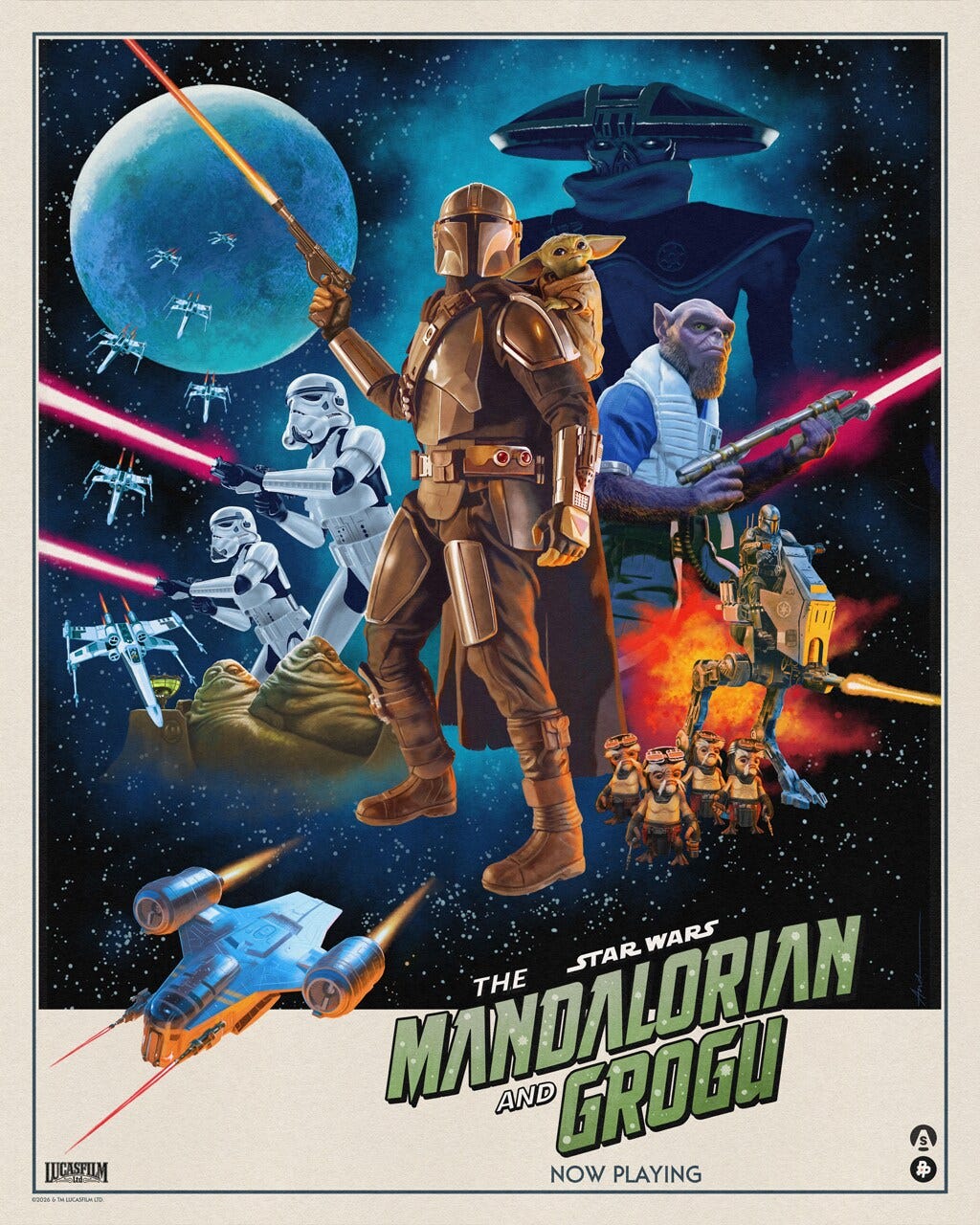
There’s a new Star Wars movie out! I wrote an emotionally taxing essay about how it made me feel old! So! As a counterweight, here’s some additional, far lighter thoughts about this good-hearted space adventure.
The Razor Crest
I read some hand wringing about the Razor Crest’s return here and there, (“Somehow, the Razor Crest returned”) but in the film itself, the reasons are pretty well explained. Sometimes it’s useful to wait for context! It’s not only treated as payment for work, but also, clearly, in a movie where he’s hauling Hutts, he’s never be able to fit his quarry into the N1 Starfighter.
One question. There’s a line in the movie I don’t understand. Mando sits in his new Razor Crest and says “It’s stock but it’s clean.” This is lingo I have no reference for. Is ‘stock,’ in this context, fresh off the assembly line? Wouldn’t that make it automatically clean? Or would a stock ship mostly be not ‘clean,’ and this is an exception? Those who understood this reference, chime in please.
Shadow Council
A fun detail: both of the Imperial Remnant overlords taken out by The Mandalorian and Grogu appear in the third season of The Mandalorian as a part of the Shadow Council. It’s a nice bit of continuity.
The Dragonsnake
I kind of love that the first thing Hutts do when they move into a stronghold, after they renovate the bathrooms, the kitchen, the slime, the looming arches, and fill the place up with creeps, is add a trap door that falls into the maw of a terrifying monster. It’s standard Hutt decor.
The Twins
What’s their deal exactly? I mean, you know? You know what I mean?
Shakari’s Salt Ration
I have a solution for salt-rationed Shakari.
Crait.
“Heel.”
Weird dialogue choice: why does Mando keep telling Grogu to heel like he’s a dog? You don’t tell kids to heel, do you? Unless there’s been some new theory of parenting that’s come into fashion while I wasn’t paying attention?
Marty
I love that Martin Scorsese, in 2019, had to defend himself in print after saying that superhero movies aren’t cinema, and now he’s a computer fry cook in Star Wars. (Although I imagine he would say Star Wars is cinema in a way that Marvel isn’t, but who knows?) Either way, Hugo Durant makes the most of his on-screen minutes, partially because his dialogue feels so freed from the constraints of the page. As I’ve said many times, Favreu’s dialogue for The Mandalorian seems almost made for people who watch the show on their phones on a commute. Here, we get the briefest contrast: a fiddly bit of funny improvisational verbiage that feels bright and alive. “I’ve got little ones at home that are smaller than him! They’re, they’re smaller!” It’s great.
Flat Meat Fry
First of all, it looks delish. Honestly, if they sold those at Galaxy’s Edge, I would eat the heck out of one. And bonus points for him using the yolk from the hairy egg of a mudhorn. Yick, yum, whichever. A cool callback for the eagle-eyed.
Marketing Mystery
I have to say, watching the movie, I’m still kind of mystified by the marketing strategy. The first sequence of the movie was shown, almost in its entirety, to audiences a few weeks prior to the release of the movie. Rotta the Hutt was heavily previewed. Embo. The Hutts. The Anzellans. X-Wings. Grogu meditating. The Dragonsnake. Zeb. Basically, if it was in the movie, the marketing showed it to you down to extended entire sequences.
I think sometimes, internally, Hollywood thinks it has to sell the viewer on the moviegoing experience. They want to say “This is a movie! Not just streaming! Look how it’s a movie! See it on the biggest screen possible!” It feels like that was at the center of this approach. Marketing the experience as different from the small screen by showing Big Screen Stuff.
I, personally, don’t think most people make decisions like that. I think people get excited about what makes them curious, what makes them compelled by a storym than the way the story is delivered to them. Regardless, the result of the marketing strategy was to rob those of us who pay quite a lot of attention of the feeling of surprise. And the film of that water cooler moment.
Imagine if no one knew that Jabba the Hutt’s son was going to be in the movie. Imagine if we weren’t expecting Grogu to meditate on a tree branch. Imagine if we hadn’t seen any of the opening, insane, John Wick sequence until opening day. The experience of it, the surprise and thrill, would have been far greater.
And they have a track record of this! Baby Yoda himself was a well-kept secret when The Mandalorian debuted. Luke Skywalker showing up at the end of Season Two was an absolute shock. I fully expected a big surprise because they deliver on big surprises often! Instead, the marketing and hype campaign went hard on Pedro Pascal’s charm and the cuteness of the baby, but didn’t hold much back for us to discover in the movie itself.
That’s really not the way Star Wars has done it in the past, by the way. So I’m unsure why the change in strategy. (I’m sure they had research on such things that lay people like me don’t see.) But sometimes, you don’t fix what ain’t broke. Star Wars has a hype template that has worked really well for it, and that included holding things back.
(Also, there’s one ad that says “There is a child whose past hold’s the key to the galaxies future! Everything depends on him!” My loves, this is not remotely implied by this movie.)
Murderer!
Holy crap does The Mandalorian kill a lot of Imperials in the opening sequence of this movie. Like, stab, torch, kick off a cliff, explode, blast and crush. Din Djarin is the world’s nicest Killing Machine. He loves that baby as he throws people to their terrible deaths. It reminded me of Indiana Jones, who really does kill a lot of Nazis. I mean, fuck ‘em, they’re Nazis… but the body count is still very high.
“Take care of your Dad”
Rotta the Hutt has two nearly identical scenes where he pats Grogu on the head and tells him to look after his Dad, because he’s saved twice in the movie, once in the middle and once in the end. It’s the clearest sign to me that the movie was built out of an episodic structure, initially.
Adelphi Squadron
Adelphi Squadron consists mostly of directors from Disney+ series and Lucasfilm luminaries like Doug Chiang. As much as these cameos are fun, and I’m sure if you work at Lucasfilm it’s cool to see, you kind of can’t beat actual actors in roles for, well, actors.
Creator-cameos are common in movies like these, but usually a little less down-in-front. In The Last Jedi, a character on a Canto Bight yacht says “Pablo Rayne Kiri” - a reference to three prominent members of the Lucasfilm Story Group. Gareth Edwards can be seen on Crait for a moment if you look closely. JJ Abrams co-wrote some of the music for The Force Awakens. John Williams appears for about two seconds in The Rise of Skywalker. George Lucas is in a wide shot in a blink-and-you’ll-miss it cameo in Episode III and his kids make quick appearances. Even Ben Burtt appears for one second in Return of the Jedi.
But there’s something about Adelphi Squadron that feels distracting in a way those felt charming. Imagine the impression Adelphi Squadron would have left if it was a series of actual actors with real screen presence? Who would have actively made the most of their minutes? Who would have desperately shouted about incoming fighters, and darted their eyes around looking for danger? You know, actors.
Peli Motto
I don’t know how you make a Mandalorian movie without Amy Sedaris! She’s the most charming character in the series. Maybe they just couldn’t figure out how to get the story to Tatooine, or whatever, but like, hologram? Hologram!
Other notable absences: The Covert, Mandalore, The Armorer, Bo-Katan, any other Mandalorians, Boba Fett and the Boba Fett company of characters, any Rebel but Zeb, any reference to Thrawn or Ahsoka, any reference to the Star Wars original trilogy characters (who are very much around in this timeline), Mon Mothma, the words Death Star, any mention of The Force, the words May The Force Be With You, anyone saying “I’ve got a bad feeling about this,” a feral droid saying “Roger Roger,” the Wilhelm scream, IG-11, Mayfield, any reference to Cara Dune, and Cobb Vanth.
The movie feels like it’s intentionally doing as little as possible to require homework, which makes sense from a certain point of view, but also leaves it a little stranded in the galaxy, actively avoiding ties to its own story. My wife, who listens to me talk about this more than any human should be forced to, and who also loves Star Wars, had to be reminded exactly when this all takes place, because there are so few clear markers.
I’m sure the theory is, if this was your introduction to Star Wars, you would start here and then watch M&G2 if the box office returns justify a sequel. (We’ll unfortunately see about that.) But if you’re referencing board games from Episode IV, why not reference your very own TV show? Speaking of which…
Dejarik
One of the coolest sequences in The Mandalorian & Grogu is the Dejarik Pit Fight. Here, we learn that the holographic chess game from A New Hope is, in fact, representing a real kind of bloody free-for-all that exists in the galaxy of Star Wars. And we see those characters brought to life, in all their weirdness. It’s a Battle Royale that’s super fun to watch, especially if you know what they’re referencing.
I will say, though, that this is one of the most Filoni Moments that I’ve ever seen. The man just loves finding stuff that already exists in Star Wars so that the most hardcore of hardcore fans can be delighted. Having Stinky from 2008 The Clone Wars Movie fight the entire Dejarik Chess Game is so many kinds of self-referential that time could fold in on itself.
I’ve said a few times that I think making Star Wars for the Celebration crowd is probably an impulse to check. Does this matter? I don’t know. You actually don’t need to know who Stinky was or remember that these monsters are from holochess for the sequence to entertain you. You get all the information you need about the scene on screen. But, of course, it works best if you do know those things.
Mad God
Speaking of which, I was delighted by how much Phil Tippett is represented in this movie. For those who don’t know, Tippett is one of the central creative forces behind early ILM and a stop motion animation guru. He is an incredible designer and animator, a person of immense vision and soulfulness. The Dejarik Pit Fight is certainly an homage to him, as he was the implementer of the original holochess game. But you can see the captivating aliveness of his work, and the work of his studio, in the battle between Din and Grogu and the massive guard droids that protect the Twins on Nal Hutta.
(If you want to really revel in how insane and unique Tippett is, check out Mad God, his magnum opus. Warning: it is Not For Children and probably not even for most adults.)
Embo
It was groovy to see a Mortal Kombat II style showdown between bounty hunters at the end of the movie, rare for Star Wars to see a one-on-one showdown that doesn’t include a lightsaber. Embo is a memorably designed character and seeing him in “live action” (sort of) was a blast.
I did wonder if a single line, as opposed to absolute silence, would have raised the stakes for his inclusion. Imagine if Embo had said “That’s for Malastare!” after he wrapped Mando in his net. Some little implication that it’s more than a job. It doesn’t take much to spark the imagination and create shared history.
Jump Scares
The Mandalorian & Grogu is rife with jump-scares. From the one-eyed sewer rat in Nal Hutta to the frog that suddenly swallows Grogu to the Amani attack on The Mandalorian when he’s searching an abandoned ship late in the film, it’s a note that’s played repeatedly. That’s not really typical in Star Wars films. The mynocks in Empire Strikes Back are a jump-scare but I really can’t remember many other instances.
The Child(s)
Gotta say, Rotta and Grogu make the cutest pair of second generation superstars. Not just because they’re such different sizes, which makes them adorbs, but because they instantly like one another. It’s as if their hearts are the same size.
“My Own Man”
Speaking of Rotta, it’s interesting how often he refers to himself as "his own man.” It’s thematically ultra-clear and easy to digest, of course, and Star Wars uses modern idioms all the time. (Captain Panaka: “We’ll be sitting ducks!”) But Rotta is, categorically, not a man. He’s a Hutt.
I’m sure there were meetings about this where they debated having him say “I’m my own Hutt” and decided that the best solution was to go with “I’m my own man!” for the sake of clarity. Still, he’s such a central character, and he says it a few times. It doesn’t feel like a toss off, but a choice. Like, was it easier to translate into international markets that way? Was the idea that kids wouldn’t care? I’d love to have been in those meetings.
Because they’re a fascinating inconsistency to how Basic and colloquialisms are used in Star Wars. I like that it’s (to quote Colonel Ward) “messy. Very messy.” Language, especially in a multi-cultural setting, is full of crossover uses, odd phrases, and mix ups. The Hutts sometimes bother with English, but mostly speak Huttese. There’s a ton of subtitling in the Original Trilogy but how and when characters are subtitled appears to have no internal rulebook. Like life.
And that’s enough for now! I’m sure I’ll have more to say in time, but those are a few scattered thoughts. Love to hear your observations too!
I thought telling Grogu to "heel" a couple times was a little weird. Like of all the things to say to get your stubborn green child to do what you want, why use a word people associate with dog training? And if you told me the next Star Wars movie was Stinky and Baby Yoda having adventures, I'd be there opening night!
With regards to "it's stock but it's clean" - I think the implication is that the new Razor Crest has no modifications (a downside vs Mando's original which was heavily customized) and is also unused in general (a positive because I'm sure the original had an old minivan energy to it)