
Star Wars: Generations
Thoughts on "Star Wars: The Mandalorian & Grogu"

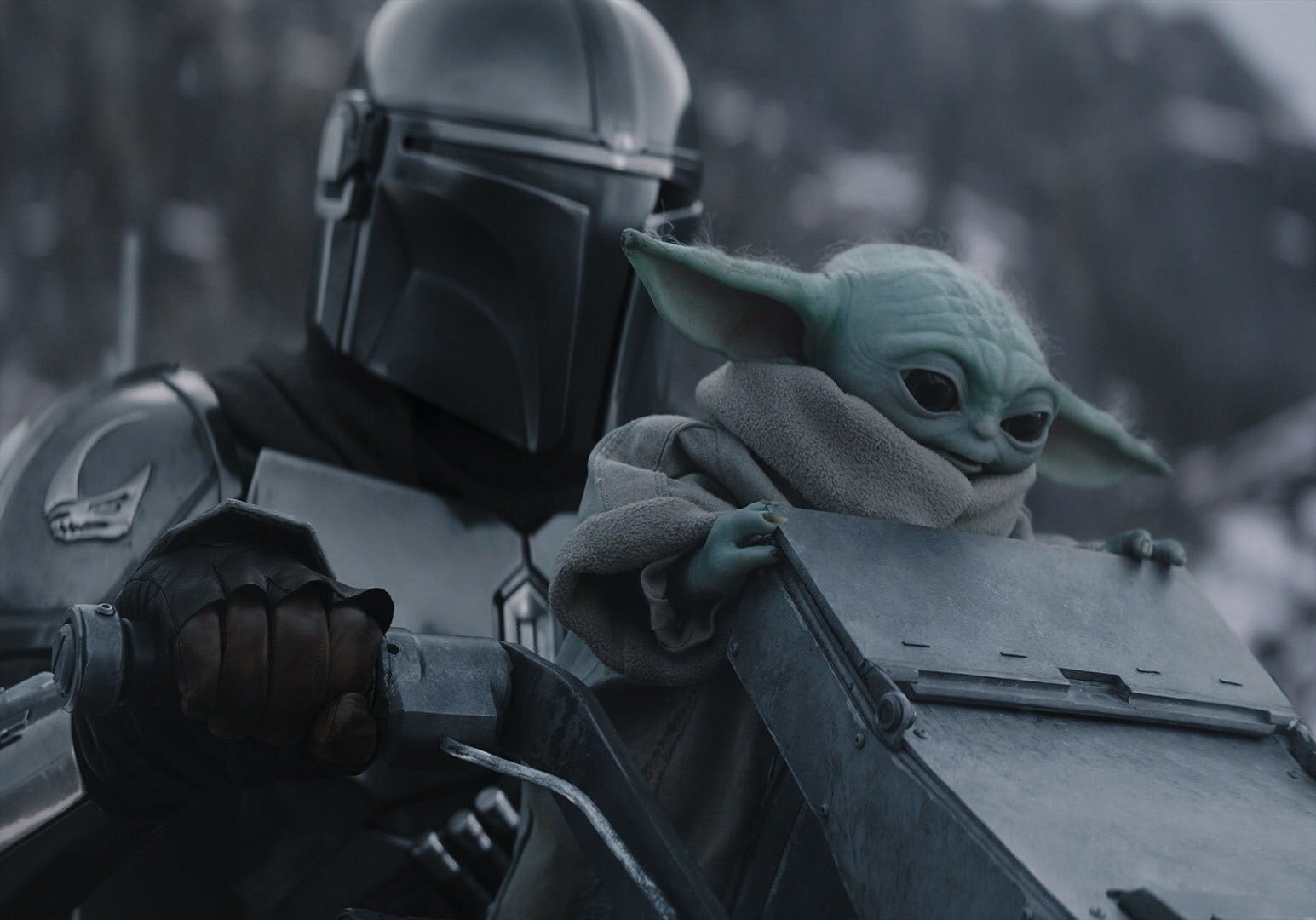
Spoilers. This Is The Way.
Like Grogu, I’m fifty years old.
Next year, Star Wars turns 50 as well. In 2027, the original Star Wars comes back to theaters, another new Star Wars film comes to the movies called Star Wars: Starfighter, and new Lucasfilm co-President’s Filoniverse continues apace with Ahsoka Season 2.
That’s a lot of fun ahead. But here’s the thing about turning 50: there’s a lot of life in your wake. That’s something I felt acutely as I watched Star Wars: The Mandalorian & Grogu this weekend I-don’t-want-to-tell-you-how-many times. This is a movie that made me think about death.
That’s not a review! I don’t really review things here. “Is it a good movie,” is usually the least interesting reaction I’m having to a Star Wars movie or show. But quickly, if you’re curious, I think The Mandalorian & Grogu is an old-fashioned adventure with some particularly inspired action sequences and a core of aw shucks sweetness. Taken on its own terms, this movie is a super-sized serving of action and heart, a worthy summer blockbuster, a massive Saturday matinee.
My review isn’t the one to give any real weight, though. Instead, listen to the little girl sitting in my row who whispered to her Mom, “That’s like you and Dad!” when Din tells Grogu not to eat too many sweets before dinner. Or listen to the little boy who shouted “I love Star Wars!” at me as he was raving about the movie to his amused family, on their way out of the theater. He saw my t-shirt, with its old fashioned Star Wars logo, and thought I should know we were on the same team. My guess? He was nine.
I am not nine. And I’m (increasingly) mortal. And this new Star Wars movie really underlined and bolded and italicized that fact for me.
Why? Because every Star Wars theatrical release prior this one has been connected, in some way, to the story that I fell in love with when I was nine. Even “Star Wars Story” films, like Rogue One and Solo, which were supposed to be stand-alone movies, were not, at all, stand-alone. They explored aspects of the saga that didn’t fit into the episodes themselves, and provided a fan like me with long-imagined material: Han Solo meeting Chewbacca, Han Solo and Lando Calrissian playing Sabacc, the capture of the Death Star Plans. Those movies had new characters and ideas, but were sprinkled with cameos and references, like a computer generated Grand Moff Tarkin or the Kessel Run. They had their eye on me, on my generation, and my obsessions.
The Mandalorian & Grogu is not involved in that project. It’s the first Star Wars film in the post-Covid, post-streaming era. And maybe because of that, it’s the first Star Wars movie that feels uninterested in reconnecting me with my childhood. This new film doesn’t have a tributary that runs from the story through a creek behind my childhood backyard to the ocean of my past. It’s not trying to reinterpret, reflect on, or excavate the Star Wars of my youth. This is the Star Wars of someone else’s youth.
And maybe that’s the point. Maybe The Mandalorian & Grogu is trying to loosen the grip of the decades-old movies that still exert a gravitational pull on Star Wars stories. Maybe its true premise is that these characters, Din Djarin and Grogu, the Space Knight and his magical frog-son, are Star Wars now. They have broken through into cultural relevance and don’t need to stand beside C-3PO or wink at a Chewbacca to earn their place in the Star Wars firmament. In the year of our lord 2026, Grogu sells more lunchboxes than the Ewoks do, after all.
The resulting entertainment, therefore, simply didn’t feel, as I watched it for the first time, like Star Wars has felt to me before. I was receiving stone tablets on Mt. Sinai when I was finally watching the The Phantom Menace after a 16 year wait. I felt like I couldn’t believe my luck when The Force Awakens unfolded for the first time. It didn’t make me feel like laugh-cheering as I finally found out what it looked like when Yoda had a lightsaber duel, after wondering about it for twenty-two years. It didn’t feel like watching two characters fight on the remains of the Death Star, which had been destroyed when I was two and again when I was seven. This movie isn’t paying off some long-delayed reward.
What it offers is more of something we’ve already seen for 27 episodes on the small screen. It isn’t responding to scarcity, but popularity. These characters have captured the public imagination, and this feels like their reward. You did it, Mando and Child, it seems to say. You belong on 4,300 screens nationwide.
That is, truly, a new Star Wars (as promised). For the metatextual reasons I described, but also, in form. The Mandalorian & Grogu is composed of different stuff than its predecessors. The John Williams score is nowhere to be found, not even in hints. (Rogue One and Solo were by different composers, but you could feel them emulating Williams. Not so here.) It has its own themes. It has opening credits, which other Star Wars films do not. It has a small, focused cast instead of a sprawling collection of characters.
It’s declarative and taciturn. It’s like someone placed a bet on how little dialogue a Star Wars movie could have and still be understood by an audience. (George Lucas once said he thought of Star Wars as silent movies, and The Mandalorian & Grogu takes up that challenge.) The Kasdan-banter that defined the earlier films isn’t even attempted.
It also doesn’t assume its own cultural relevance. We’ve been told that Jon Favreau and Dave Filoni wanted this movie to stand on its own and act as a kind of jumping on point for new audiences. This film offers a sealed narrative that assumes and expects no knowledge of Star Wars or these characters. It doesn’t even really require you saw the TV show that inspired it.
That’s a truly different position for Star Wars to take, too. Except for A New Hope, every Star Wars film was made with dual assumptions: that it was for everyone, and that it was a defining part of the pop culture zeitgeist. George Lucas made very geeky movies that were super entertaining on their own terms, but also functionally assumed you knew that Anakin Skywalker was going to become Darth Vader someday. They weren’t made for Star Wars fans, they assumed everyone was basically a Star Wars fan.
In laying out all these differences, it sounds like I’m critiquing the movie and I want to stress, that’s not my point. There’s really nothing the movie promises it doesn’t deliver on. It’s great fun and audiences I saw it with loved it. Cheered and clapped. What I’m wrestling with is that, after so much time and so many first-time viewings of highly-anticipated Star Wars, I’d come to expect something else from Star Wars. I was surprised by the absence of the familiar. And, because I felt that absence, while watching the movie for the first time, I had the uncomfortable fear that Star Wars, as I knew it, was being replaced by something else.
In Revenge of the Sith, Anakin sits before Yoda and confesses he’s been having premonitions of death and asks what he must do. Yoda tells him to train himself to let go of everything he fears to lose. Fear of loss, of course, is the path to the Dark Side. That’s sage advice for this fifty year old Star Wars fan watching The Mandalorian & Grogu. Because the Star Wars I grew up with isn’t gone (no one’s ever really gone): it’s right there, for me to enjoy, at any time. There will be new stories to come that may display something more akin to the Star Wars I grew up with. For now, instead of sitting in the dark wondering why this doesn’t feel like the other movies to me, I’ve had to remind myself to enjoy what it is instead of mourn what it isn’t.
In the final stretch of The Mandalorian & Grogu, Din Djarin bravely faces down feral droids in a moment reminiscent of Boromir protecting the Hobbits in the Fellowship of the Ring. Our hero defeats the Hutt’s droid-orcs so that his friends can fly away (in a ship that’s, hilariously, too small for the planned rescue) and then collapses in the swamp, succumbing to Dragonsnake poison.
Then, Grogu appears. For a transcendent segment of the movie, we see The Child on his own, keeping watch over his fallen father. It’s a section of the film that’s reminiscent of The Dark Crystal: a puppet makes its way through an overgrown forest, examining the environs, gathering resources, meditating. The music swells and maps this emotional mini-adventure, as Grogu wordlessly nurses his father back to health.
Here, we see Din’s greatest fear confronted. Grogu will live for hundreds of years, and The Mandalorian will not always be there to protect him. Even if they are faithful to each other through every adventure, and they overcome every foe, eventually, Din Djarin will transform into the Force before his adopted son does. A new generation is always on the horizon, needing to be nurtured, and learning to nurture in return. Something comforting is in those scenes for the fan who wonders if Star Wars will be Star Wars without the Skywalkers and John Williams and Lawrence Kasdan. Take care of what you love, even if you know it will not always need you. It will take care of you in return.
In these cynical times, watching the story of a very healthy relationship is (as James Gunn’s Superman said) the new punk rock. But that brings me to the biggest generational difference I felt as I watched The Mandalorian & Grogu. This is not a story that emerges from the pain of a generation trying to reconcile itself to the sins of the past. This is about the pure love a parent and child can share, and how that love can give the two of them strength that they would not have on their own.
I am a child of the 80s divorce boom. I resonated with Luke Skywalker’s desire to leave the confines of my home, to get away, “to strive to seek to find and not to yield”. I felt moved by the idea of someone whose past, whose family, leaves them unsure of how to feel. Does one embrace their family history or overcome it? George Lucas was making stories that came from his own generation, emerging from the chaos of the 1960s, the post-Vietnam, post World War II cultural imagination. To find a language to confront those times, he reached even further back, to the 1950s and the serials of the 1930s. It’s been generations trying to reconcile with generations.
This new Star Wars has something else it wants to talk about. And that thing seems to be simply connecting with one another. Being kind. Taking care of one another. The Mandalorian & Grogu aren’t tortured souls wondering who they’re going to be. They’re not even revolutionaries, in particular. They’re sweethearts. They just want to go to their house and have dinner. The New Republic isn’t a scrappy collection of weirdos on the run, like the Rebellion, they’re a clean-up crew in the aftermath of a great struggle, trying to figure out what the fight really looks like now. They’re having some coffee and playing air hockey in the clubhouse as they one by one find the remains of their vanquished foe. I’m sure if you’re a young person growing up in the current cultural morass, just watching someone be a really great Dad to a really sweet kid is speaking to what you need, at this time. I imagine watching a clean-up crew feels resonant too. We’re certainly going to need one in a few years.
But when I was a kid, the distress of Luke Skywalker was not traumatic, it was affirming. I wanted to be a Rebel, and to grow and change, and really, never settle down completely. And, true to form, my life has been mostly looking to the horizon. The Mandalorian & Grogu aren’t looking to the horizon. They’re looking to get back home safely, a few credits in their pocket, having grown closer as family.
How does that make me feel? Like I will not live forever! Like things move on, move forward, evolve and change. New themes have emerged from the culture. It’s an essential theme of the film. Inevitable loss. The passage of time. Life will carry on without us, eventually. And all we can do is make sure we’re treating those we are meant to care for, right now, like they will someday lose us. And cherish them for it, and leave them better than we found them.
George Lucas created a generational story, a mythology more than a popcorn franchise. In order for that to be true, it can’t be trapped in constant self-reference and self-reverence, admiring itself like Narcissus. It has to, in key moments, let go and start again. This may be that moment, I don’t know. Maybe, in fifty years, someone will write about how they can’t believe they’re watching the final story of The Mandalorian & Grogu, who they grew up with and who inspired them to be a great mom or dad.
That won’t be me, I probably won’t be here for that.
But it could be that kid I walked past as he was leaving the theater, calling out to a middle aged man in a Star Wars shirt, shouting “I love Star Wars” to anyone who would listen.
I hope it is.
I hope Star Wars lasts long enough that he gets to have as much fun as I’ve had.
Hop on, kid.
I have read two formal reviews of the movie, one informal review (by the one-and-only Jeff K), and now this. As usual, you have written the best article and I know that I won't read a better one.
I have been to the theaters many times throughout my life. It warms my heart thinking about the various reactions (all positive) that I have observed from children at Star Wars movies. God bless them, including those two children you mentioned. Ultimately, Star Wars is for them. In a way, it always has been.
P.S. I haven't seen the film yet, but I managed to skip over those paragraphs in which you discuss the ending.
I felt so emotional reading this, what a wonderful take on the movie and what it signifies. I waited until I saw the movie before reading this, and I definitely resonate.
I'm 39 and my mother introduced me to these movies in the 90s - before the prequels came out - and I was instantly hooked. Thank you for writing this!