
Speed Run
The Book of Boba Fett, Season 1, Chapter 3 - "The Streets of Mos Espa"

Last Fall (!) I started a The Book of Boba Fett rewatch that stalled after two episodes when lots of other exciting Star Wars news took precedence. Now, with The Mandalorian & Grogu playing in theaters, I think it’s time to get back to this rewatch. You can catch up with Chapter 1 “Stranger in a Strange Land” here and Chapter 2 “The Tribes of Tatooine” here.
If the second episode of The Book of Boba Fett is overflowing with cool stuff and wish fulfillment, the third episode slows things down considerably. Which is ironic for reasons we’ll get into below! But, essentially, this episode’s split-stories both delve into Boba Fett losing one tribe and beginning to gather another.
In flashback territory, Boba Fett meets with the Pykes in Mos Eisley to wrangle protection money on behalf of his new Tusken tribe. Turns out, the Pyke Syndicate claims they already pay protection money to a gang called the Kintan Striders and they refuse to pay two parties. Fett says he’ll settle the matter, and returns home to find his new family slaughtered (already?!), next to graffiti that seems into indicate, perhaps too neatly, that the Kintan Striders themselves are to blame.
In real-ish time, Boba Fett is managing being Daimyo of Mos Espa. We get a pointer scene voiced by Droid Matt Berry (less funny than you might hope) explaining how different criminal clans divide up Mos Espa. A “water monger’ named Lortha Peel shows up without an appointment (“Apologies,” he says. A lot of characters say “Apologies” in The Book of Boba Fett), asking for help with criminals who have stolen his goods.
These criminals turn out to be Mods: a roving gang of teens who have made cybernetic modifications to their bodies the way some street gangs might have tattoos. (This is borderline not-very-Star Wars, but it’s hard to say exactly why.) They explain that they’re being charged a month’s wage for a week’s supply of water, which is why they stole it, and maybe Boba Fett could go back to his stronghold and screw himself, basically. Boba Fett, impressed with their defiance, hires them to be his very own squad of hooligans (it was a job interview!) and tells the Water Monger to lower his prices.
Other notable moments from the episode: The Twins (who recently reappeared as the villains of The Mandalorian & Grogu) send Black Krrsantan, a Bounty Hunter Wookie lifted from the comics, to try to kill Boba. When he fails, The Twin appear and offer tribute: a pet rancor, who will factor into the series finale. The trainer that comes along with the rancor? None other than Machete himself: Danny Trejo. It’s neat, more or less, if it’s mostly a lot of standing around and talking.
There’s just mountains of Star Wars-y Star Wars in this Star Wars. Meiloorun fruit makes an appearance (from Rebels!) A rickshaw droid ala Attack of the Clones appears. We find out that Tatooine was once covered in water - no one elaborates, it’s just a little lore. We find out that rancors are the pit bulls of the Star Wars universe: actually loving and harmless unless they’re trained to hurt people. Lots of Star Wars slang (“You better fight as good as you talk dank” “Don’t work for scug holes.”) There’s even an appearance of a painting of Jabba the Hutt that is, in fact, concept art from Return of the Jedi by Ralph McQuarrie. There are so many Easter Eggs that you’d think it was released on Easter Sunday.
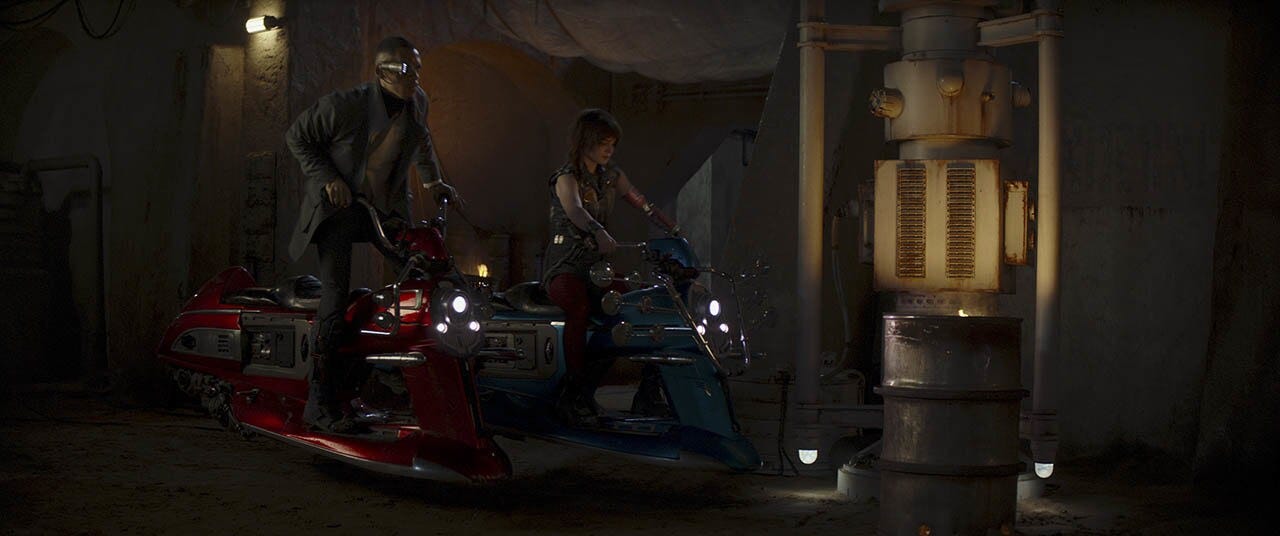
So why does this episode feel so, I don’t know, inert? The Streets of Mos Espa features some of the best actors working anywhere, like Stephen Root (Barry, Widow’s Bay, everything good really) and Sophie Thatcher (Yellowjackets, Heretic, Companion); what should be a show-piece race through the titular streets of Mos Espa on modified, primary colored speeder bikes; major deaths; and a throw down between a Wookie in Spiked Armor and Boba Fett himself.
The problem is, I think, that this episode doesn’t take the essential advice of the Maker: faster and more intense. It’s leisurely. (This issue was really pronounced in the Ahsoka series too.) Stephen Root, an absolutely electric actor, stands still in the frame and says exactly what his character believes out loud several times. There’s not a lot of blocking, not a lot of surprise. He tells us what he wants, and then tells us how he feels, and that’s about it. Sophie Thatcher, a Chicago native saddled here with an unconvincing British accent, also kind of just states her case without a sense of urgency. They’re not doing career best work here. They’re just recognizable faces, saying stuff, and not being in a particular hurry to get anywhere.
Star Wars is famous for its obsession with speed. George Lucas loved a drag race and a dog fight, and he wanted flying to feel fast, racing to make our hearts race. He wanted rapid movement through the frame. Quick cuts. His original band of ILM weirdos invented whole new ways to make things look quick. From the original Death Star Trench Run to the Millennium Falcon scraping through an asteroid field to Luke and Leia on speeder bikes on Endor to the Pod Race; it’s a story full of throttle. Marcia Lucas, who recently passed away, may well have been the secret editing weapon in that regard, establishing the pace of cuts and movement that defined the early series and everything after.
Which is what makes “The Streets of Mos Espa”s attempts to speed things up so memorably off. In the last episode, the pulled of a train heist that feels fast, dangerous and cinematic on a streaming series budget and schedule. In Chapter Three? The Mods chase down the majordomo in the final sequence that’s best use is, to be kind, contrast. It proves that Star Wars’s success at mimicking speed is harder than it looks to technically achieve.
In the theater world (where I live most of the time) it’s often said that you only notice certain elements, like lighting design, if they’re being clumsily applied. Watch the final chase through Mos Espa and then put on the speeder bike chase in Return of the Jedi. You’ll notice all the missing techniques that made it feel, in 1983, like Luke and Leia and the stormtroopers were hurtling through danger. Now, years later, with digital technology that should make it easy emulate, The Book of Boba Fett doesn’t quite pull it off.
That all being said, the real story of Boba Fett here is about being lost and found. Fett’s closest friend and confidant, Fennic Shand, is a single, wounded warrior. His briefly won tribe is taken from him all the sudden. And his Palace, where Jabba The Hutt once filled the halls will creatures and singers, are emptied and quiet.
In this episode, we begin to see him recover from this loss. He frees Krrsantan (an act that will win him an ally); hires the mods (meaning his backup grows considerably); and he fawns over a baby rancor, in a menacing meet-cute.
And he’ll need that help. As we see at the end of the episode, we close the book on How Did Boba Fett Survive and begin the show’s real-time struggle against the Pyke’s invading Tatooine. The Pykes apparently don’t see a new Daimyo where Boba Fett stands: they see a power vacuum waiting to be filled.
One final thought: The Book of Boba Fett certainly plays a little differently now that there’s a Star Wars film in theaters. It feels less like a speedbump between Mandalorian seasons and more like an essential part of the New Republic era story. It’s here, after all, in this series, that Luke Skywalker trains Grogu. It’s here, after all, in this series, that we meet the Twins who will be so consequential. If you’re getting caught up or revisiting this era after seeing Din and baby on the big screen, don’t forget to check in on Boba Fett’s actually very important book.
Thanks for reading my musings on Mos Espa. Tune in next week, as they say, for “The Gathering Storm!” (I hope it won’t take me months to write some thoughts about that one! Thanks for your patience!)
Wow, thanks for coming back to this. I thought you simply abandoned the project and that was that.
Taking this as a sign that I should rewatch Book of Boba Fett. I watched the last 3 episodes for my Mando rewatch before the movie. Also, I had completely forgotten Stephen Root is in it.